
Thomas Jeremiah, America's Founding, and the Importance of Telling the Whole Story
By Dr. Eric M. Wallace
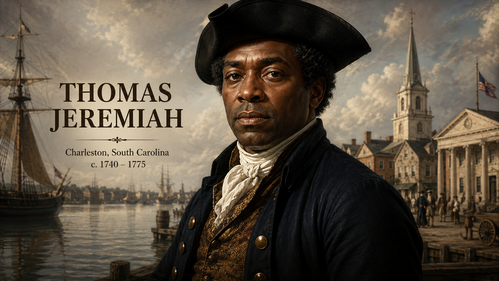
I recently watched a social media depiction of Thomas Jeremiah, a free Black businessman who lived during America's struggle for independence from Great Britain. The post portrayed Jeremiah as the victim of false accusations by South Carolina Patriots who alleged that he was collaborating with the British and inciting a slave revolt, charges that ultimately led to his execution in 1775. It then went a step further, using Jeremiah's tragic death to indict the Founding Fathers as hypocrites and to dismiss the American Revolution itself as little more than a fraudulent exercise in liberty.
The post failed, either on purpose or out of ignorance, to understand the full context of the struggle.
To be clear, Thomas Jeremiah's execution was a profound injustice. A prosperous free Black harbor pilot and businessman in Charleston, South Carolina, Jeremiah became the victim of a society gripped by fear. South Carolina's slaveholding elite worried that the British might encourage enslaved people to rise against their masters, and Jeremiah's alleged connections to the Crown made him a convenient scapegoat. The evidence against him was weak, and even the colony's royal governor questioned the legitimacy of his conviction and execution. His death should be remembered as one of the moral failures of the Revolutionary era.
But it is one thing to condemn the actions of South Carolina's pro-slavery Patriots and another thing entirely to condemn the entire American founding. History is far more complicated than the social media caricatures that dominate our public discourse, and the very drafting of the Declaration of Independence proves it.
In Thomas Jefferson's original draft, he condemned King George III for perpetuating the slave trade, writing that the king had "waged cruel war against human nature itself, violating its most sacred rights of life and liberty in the persons of a distant people." Jefferson went even further, accusing the Crown of keeping open a market "where men should be bought and sold."
Those words never made it into the final document. Delegates from South Carolina and Georgia objected to the anti-slavery language, and some northern commercial interests that had profited from the trade were also uncomfortable with the condemnation. To preserve the unity needed to declare independence, the grievance was removed.
That fact alone destroys the simplistic narrative that all the Founders thought alike on slavery. Some Patriots were unapologetically pro-slavery and feared anything that threatened the institution. Others opposed the slave trade and hoped for its eventual abolition. Still others recognized the contradiction between slavery and the principles of the Revolution but believed independence had to come first. The debate over slavery was present from the very beginning, and Thomas Jeremiah's story illustrates one side of that tension. His execution reveals the fear and moral failure of South Carolina's slaveholding elite. It does not prove that every Patriot or every Founder shared their views or their actions.
Indeed, the principles articulated in the Declaration eventually became the very arguments used to challenge slavery itself. The words "all men are created equal" and that they are "endowed by their Creator with certain unalienable Rights" became the rallying cry of abolitionists, Black church leaders, and civil rights activists. No one understood this better than Frederick Douglass, who declared in his famous Fourth of July address: "The principles contained in that instrument are saving principles. Stand by those principles, be true to them on all occasions, in all places, against all foes, and at whatever cost." Douglass called the Declaration "the ring-bolt to the chain of your nation's destiny," and years later, after carefully studying the Constitution, concluded that "interpreted as it ought to be interpreted, the Constitution is a glorious liberty document."
That statement should give pause to those who wish to dismiss the American founding altogether. One of America's greatest Black abolitionists did not reject the Declaration or the Constitution. He appealed to their principles to condemn slavery and to call the nation to repentance.
The aftermath of the Revolutionary War further complicates the simplistic social media narrative. Thousands of enslaved people gained their freedom during and after the conflict. Northern states began the process of gradual emancipation. The institution of slavery, though tragically preserved in the South, came under sustained moral and political attack because of the very ideas unleashed by the American Revolution.
None of this excuses the sins of slavery or diminishes the tragedy of Thomas Jeremiah's death. Neither should Jeremiah's story be weaponized to condemn the entire American experiment, or to suggest that liberty and hypocrisy are the only two categories through which our history can be understood. America's founding was neither a flawless triumph nor an irredeemable fraud. It was a nation struggling to live up to principles that were greater than many of the men who proclaimed them, and the tension between those principles and their imperfect application has defined much of our national story.
Sadly, we live in an age where many people approach history not as a search for truth but as a means of advancing an agenda, bending the narrative with half-truths, misinformation, and outrage to score ideological points. Thomas Jeremiah deserves better than to become a prop in someone else's political argument. His story should remind us that the struggle for liberty in America has always been complicated, contested, and unfinished, and that truth requires context, not slogans and social media posts.
Now that the celebrations surrounding America's 250th anniversary have passed, perhaps this is the perfect time to remember the whole story, the triumphs and the failures, the heroes and the hypocrites, the ideals and the contradictions. Keeping the record straight is not an exercise in defending the past. It is an act of faithfulness to the truth.
And the truth is this: the same founding principles that were imperfectly applied in 1776 eventually became the moral foundation upon which slavery was challenged, segregation was dismantled, and civil rights were secured.
A free people cannot remain free if they lose the ability to tell the truth about their own history. Responsible Government requires an honest accounting of the past. Individual Liberty and Fidelity demand that we resist ideological distortions and remain faithful to the truth, even when it is complicated. Strong Family Values depend upon passing on an accurate understanding of our nation's history to the next generation. And Economic Empowerment flourishes only in a society that trusts its institutions because they are grounded in truth rather than propaganda.
Thomas Jeremiah's story is therefore not an indictment of America's ideals. It is a reminder of how difficult, and how necessary, it is for a nation to live up to them. The American experiment has always been a struggle to close the gap between our creed and our conduct. The answer is not to abandon the creed, but to embrace it more fully and to summon each generation to live up to its enduring promise.
I recently watched a social media depiction of Thomas Jeremiah, a free Black businessman who lived during America's struggle for independence from Great Britain. The post portrayed Jeremiah as the victim of false accusations by South Carolina Patriots who alleged that he was collaborating with the British and inciting a slave revolt, charges that ultimately led to his execution in 1775. It then went a step further, using Jeremiah's tragic death to indict the Founding Fathers as hypocrites and to dismiss the American Revolution itself as little more than a fraudulent exercise in liberty.
The post failed, either on purpose or out of ignorance, to understand the full context of the struggle.
To be clear, Thomas Jeremiah's execution was a profound injustice. A prosperous free Black harbor pilot and businessman in Charleston, South Carolina, Jeremiah became the victim of a society gripped by fear. South Carolina's slaveholding elite worried that the British might encourage enslaved people to rise against their masters, and Jeremiah's alleged connections to the Crown made him a convenient scapegoat. The evidence against him was weak, and even the colony's royal governor questioned the legitimacy of his conviction and execution. His death should be remembered as one of the moral failures of the Revolutionary era.
But it is one thing to condemn the actions of South Carolina's pro-slavery Patriots and another thing entirely to condemn the entire American founding. History is far more complicated than the social media caricatures that dominate our public discourse, and the very drafting of the Declaration of Independence proves it.
In Thomas Jefferson's original draft, he condemned King George III for perpetuating the slave trade, writing that the king had "waged cruel war against human nature itself, violating its most sacred rights of life and liberty in the persons of a distant people." Jefferson went even further, accusing the Crown of keeping open a market "where men should be bought and sold."
Those words never made it into the final document. Delegates from South Carolina and Georgia objected to the anti-slavery language, and some northern commercial interests that had profited from the trade were also uncomfortable with the condemnation. To preserve the unity needed to declare independence, the grievance was removed.
That fact alone destroys the simplistic narrative that all the Founders thought alike on slavery. Some Patriots were unapologetically pro-slavery and feared anything that threatened the institution. Others opposed the slave trade and hoped for its eventual abolition. Still others recognized the contradiction between slavery and the principles of the Revolution but believed independence had to come first. The debate over slavery was present from the very beginning, and Thomas Jeremiah's story illustrates one side of that tension. His execution reveals the fear and moral failure of South Carolina's slaveholding elite. It does not prove that every Patriot or every Founder shared their views or their actions.
Indeed, the principles articulated in the Declaration eventually became the very arguments used to challenge slavery itself. The words "all men are created equal" and that they are "endowed by their Creator with certain unalienable Rights" became the rallying cry of abolitionists, Black church leaders, and civil rights activists. No one understood this better than Frederick Douglass, who declared in his famous Fourth of July address: "The principles contained in that instrument are saving principles. Stand by those principles, be true to them on all occasions, in all places, against all foes, and at whatever cost." Douglass called the Declaration "the ring-bolt to the chain of your nation's destiny," and years later, after carefully studying the Constitution, concluded that "interpreted as it ought to be interpreted, the Constitution is a glorious liberty document."
That statement should give pause to those who wish to dismiss the American founding altogether. One of America's greatest Black abolitionists did not reject the Declaration or the Constitution. He appealed to their principles to condemn slavery and to call the nation to repentance.
The aftermath of the Revolutionary War further complicates the simplistic social media narrative. Thousands of enslaved people gained their freedom during and after the conflict. Northern states began the process of gradual emancipation. The institution of slavery, though tragically preserved in the South, came under sustained moral and political attack because of the very ideas unleashed by the American Revolution.
None of this excuses the sins of slavery or diminishes the tragedy of Thomas Jeremiah's death. Neither should Jeremiah's story be weaponized to condemn the entire American experiment, or to suggest that liberty and hypocrisy are the only two categories through which our history can be understood. America's founding was neither a flawless triumph nor an irredeemable fraud. It was a nation struggling to live up to principles that were greater than many of the men who proclaimed them, and the tension between those principles and their imperfect application has defined much of our national story.
Sadly, we live in an age where many people approach history not as a search for truth but as a means of advancing an agenda, bending the narrative with half-truths, misinformation, and outrage to score ideological points. Thomas Jeremiah deserves better than to become a prop in someone else's political argument. His story should remind us that the struggle for liberty in America has always been complicated, contested, and unfinished, and that truth requires context, not slogans and social media posts.
Now that the celebrations surrounding America's 250th anniversary have passed, perhaps this is the perfect time to remember the whole story, the triumphs and the failures, the heroes and the hypocrites, the ideals and the contradictions. Keeping the record straight is not an exercise in defending the past. It is an act of faithfulness to the truth.
And the truth is this: the same founding principles that were imperfectly applied in 1776 eventually became the moral foundation upon which slavery was challenged, segregation was dismantled, and civil rights were secured.
A free people cannot remain free if they lose the ability to tell the truth about their own history. Responsible Government requires an honest accounting of the past. Individual Liberty and Fidelity demand that we resist ideological distortions and remain faithful to the truth, even when it is complicated. Strong Family Values depend upon passing on an accurate understanding of our nation's history to the next generation. And Economic Empowerment flourishes only in a society that trusts its institutions because they are grounded in truth rather than propaganda.
Thomas Jeremiah's story is therefore not an indictment of America's ideals. It is a reminder of how difficult, and how necessary, it is for a nation to live up to them. The American experiment has always been a struggle to close the gap between our creed and our conduct. The answer is not to abandon the creed, but to embrace it more fully and to summon each generation to live up to its enduring promise.

Dr. Eric M. Wallace, author of the new book, The Heart of Apostasy: How The Black Church Abandoned Biblical Authority for Political Ideology--And How to Reclaim It, is a trailblazing scholar, dynamic speaker, and passionate advocate for faith-based conservatism. With a distinguished academic background and an unwavering commitment to biblical truth, Wallace has become a leading voice challenging cultural and political narratives that conflict with a biblical worldview.
Wallace holds postgraduate degrees in biblical studies (M.A., ThM, Ph.D.), Wallace is the first African American to earn a Ph.D. in biblical studies from Union-PSCE (now Union Presbyterian Seminary). His scholarship and ministry experience equip him to address today’s most pressing sociopolitical issues through the lens of faith, reason, and historical accuracy.
Wallace holds postgraduate degrees in biblical studies (M.A., ThM, Ph.D.), Wallace is the first African American to earn a Ph.D. in biblical studies from Union-PSCE (now Union Presbyterian Seminary). His scholarship and ministry experience equip him to address today’s most pressing sociopolitical issues through the lens of faith, reason, and historical accuracy.
Recent
The Big Tent Party: Right? Sure? Whatever?
September 30th, 2026
Maybe we've become too Selfish?
August 20th, 2026
Equal Before God, Unequal in Gifts
August 20th, 2026
Beyond Personality Politics: A Biblical Framework for Evaluating Our Leaders
July 27th, 2026
The NAACP's Moral Crisis: When Civil Rights Abandons Biological Reality
July 8th, 2026
Archive
2026
January
March
THE GEOPOLITICAL CHESSBOARD AND THE SPIRITUAL WAR WE’RE IGNORING--Part 1THE SPIRITUAL DIMENSION AND THE CHURCH’S COMPLICITY--Part 2Racism, Sin, and the Republican Party: A Christian ResponseA Moment of Reflection on the Life of Rev. Jesse Jackson Sr.Black Americans Are Not Hyphenated CitizensWhen “Jesus Never Said That” Becomes a License for ApostasyWhen Scripture Is No Longer First: The Heart of Apostasy in the Black Church and American PoliticsDemocrats Good……Trump Bad
April
When Conviction Becomes Costly: Faith, Culture, and the Silence of the ChurchNo Savior but Christ: When Politics Crosses a Sacred LineWhat Good Is a Worldview If We Are Not Guided by It?When Resurrection Sunday Becomes Interfaith: Why the Church Must Guard the GospelSocialism in the City: When Government Tries to Play GodWords Matter: The Dangerous Illusion Behind “Mass Incarceration”More Degrees, More Debt, Less Direction: Why Illinois Is Looking the Wrong Way on Workforce DevelopmentNow, I suppose, he’s a Hitlerian KingJustice Without Partiality: What the Louisiana Ruling Reveals About America’s Heart
May
June
July
America at 250 and Freedom's Journal at 200: The Unfinished Work of FreedomThomas Jeremiah, America's Founding, and the Importance of Telling the Whole StoryThe NAACP's Moral Crisis: When Civil Rights Abandons Biological RealityBeyond Personality Politics: A Biblical Framework for Evaluating Our Leaders
2025
February
March
July
September
October
November
2024
January
Cartoon 01/01/24Cartoon 01/02/24Claudine Gay Betrayed the American Values of My Black Elders to Exploit White GuiltCartoon 01/03/24Cartoon 01/05/24Cartoon 01/06/24Cartoon 01/07/24Cartoon 01/08/24We need a David, not a SaulCartoon 01/13/24Cartoon 01/09/24Cartoon 01/10/24Cartoon 01/11/24Cartoon 01/14/24Cartoon 01/12/24What Happens to a King Deferred? A ReduxCartoon 01/15/24Cartoon 01/16/24The Good Guys with Guns Part 1Cartoon 01/17/24America Works. DEI Doesn’t.Cartoon 01/18/24Cartoon 01/23/24Good Guys with Guns Part 2Cartoon 01/19/24Cartoon 01/21/24Cartoon 01/22/24Cartoon 01/24/24Cartoon 01/26/24Cartoon 01/25/24Cartoon 01/27/24
No Comments